Predicting immunity.
Powering drug discovery.

A scalable, human-relevant platform that models immune responses in days — so teams catch immune-safety signals earlier and rely less on animal models.

8-14 days

From sample to human-relevant immune data.

100%

Human cell-based 3D culture platform.

$1.5B+

Immunotoxicology market opportunity.

Immune safety testing reimagined for modern drug development

Drug development still relies on animal models that often fail to predict human outcomes. Lympha Bio builds scalable human in vitro novel alternative methods (NAMs) to help pharmaceutical companies and research teams assess immune toxicity earlier, reduce late-stage failures, and improve confidence in preclinical decisions – at a lower cost.

Why drug develop needs a more human approach
Nine out of ten drugs that make it into clinical trials never reach patients, and most of the fallout lands in Phase II and III — after years of work — when safety or efficacy problems finally surface. A significant share of those late failures trace to immune-related effects that animal studies don’t reliably predict. Surface that immunotoxicity earlier, in a human-relevant system, and much of it becomes catchable before the costliest trials begin.

Source: Sun et al., “Why 90% of clinical drug development fails and how to improve it,” Acta Pharmaceutica Sinica B (2022).

The most rigorous estimate of bringing a single drug to market — about $2.6 billion to approval, and roughly $2.8 billion once post-approval R&D is counted — is dominated by the price of failure, carried across every candidate that didn’t make it. Because those failures tend to appear only after enormous investment, moving the point of detection earlier is one of the few levers that genuinely bends the curve. That’s the case for better human data up front.

Source: DiMasi, Grabowski & Hansen, “Innovation in the pharmaceutical industry: New estimates of R&D costs,” Journal of Health Economics (2016).

Mouse models are a famously unreliable stand-in for the human immune system. In one landmark analysis, the genomic responses driving human inflammatory conditions showed little correlation with the mouse models meant to represent them. When the biology diverges that early, strong preclinical results don’t survive contact with real patients — a large part of why so many drugs fail late. Testing against human immune tissue from the start takes the guesswork out.

Source: Seok et al., “Genomic responses in mouse models poorly mimic human inflammatory diseases,” PNAS (2013).

The shift to human-relevant testing is accelerating

Regulatory change, growth in biologics, and increasing demand for predictive preclinical systems are driving rapid adoption of non-animal models across pharma and CROs.

Signed into law, this Act ended the blanket federal requirement that new drugs be tested in animals before human trials — opening the door to human-relevant methods.

Antibodies and cell- and gene-therapies now lead drug pipelines, and their immune effects are exactly what animal models predict least reliably.

U.S. agencies move from permitting to actively prioritizing and funding NAMs, including organ-on-chip systems.

Human-relevant immune models cut risk, sharpen prediction, and move safer therapies to patients sooner.

Model human immune responses in days

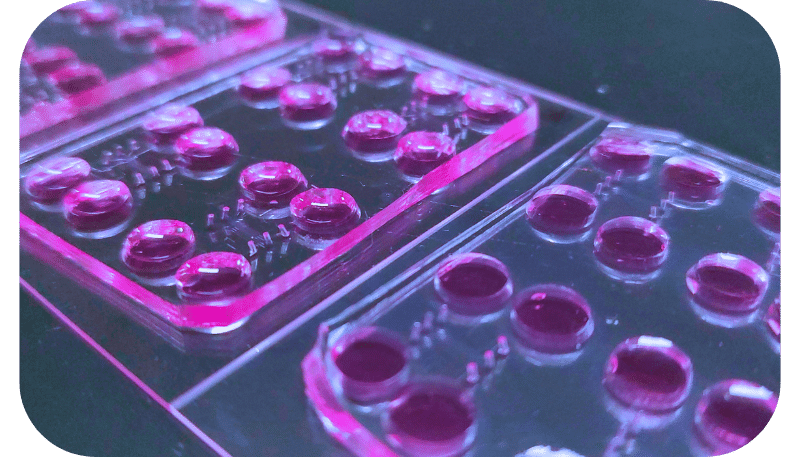
Lympha Bio’s lymph-node-on-a-chip recreates key human immune responses in a scalable format. Evaluate antibody production, immune activation, and immunotoxicity with human cells in a simple, ready-to-adopt workflow or service model.

Platform applications

Built for biologics, monoclonal antibodies, vaccines, and emerging immunotherapies, Lympha Bio’s growing platform offers scalable immune testing across multiple use cases.

LymphaTox

Human T-dependent antibody response (TDAR) immunotoxicity testing. Introducing an all-new scalable, affordable in-vitro TDAR assay.

In Development Validation Launch

Booster assays

Memory-response antibody and cellular immune profiling. A comprehensive read on how human immunity responds to a candidate.

In Development Validation Launch

De novo assays

Novel-antigen testing to evaluate vaccine candidates and ‣ in a scalable, human-relevant immune microenvironment.

In Development Validation Launch

We’re recruiting strategic pharmaceutical partners to evaluate our immunotoxicology platform.

Built by leaders in immunology and tissue engineering

Rebecca Pompano, Ph.D.

President, Co-Founder

Pioneering researcher in lymph node tissue engineering and immunology. Leading the translation of academic breakthroughs into practical therapeutic tools.

Jennifer Munson, Ph.D.

Secretary, Co-Founder

Expert in microphysiological systems. Bringing advanced tissue engineering to the forefront of immune safety testing.

Chance Luckey, M.D., Ph.D.

Senior Advisor

Deep clinical and research expertise in immunology and translational medicine. Guiding platform validation and clinical translation strategy.

Deep expertise in immune modeling, tissue engineering, and translational biotech, built to turn rigorous academic science into practical drug-development tools.

Federally and institutionally backed

Tissue Chip Consortium funding for enabling technology, 2019–2026

Awarded 2024 for innovation in human-relevant biomedical research tools

Virginia Innovation Partnership Corporation, awarded December 2025